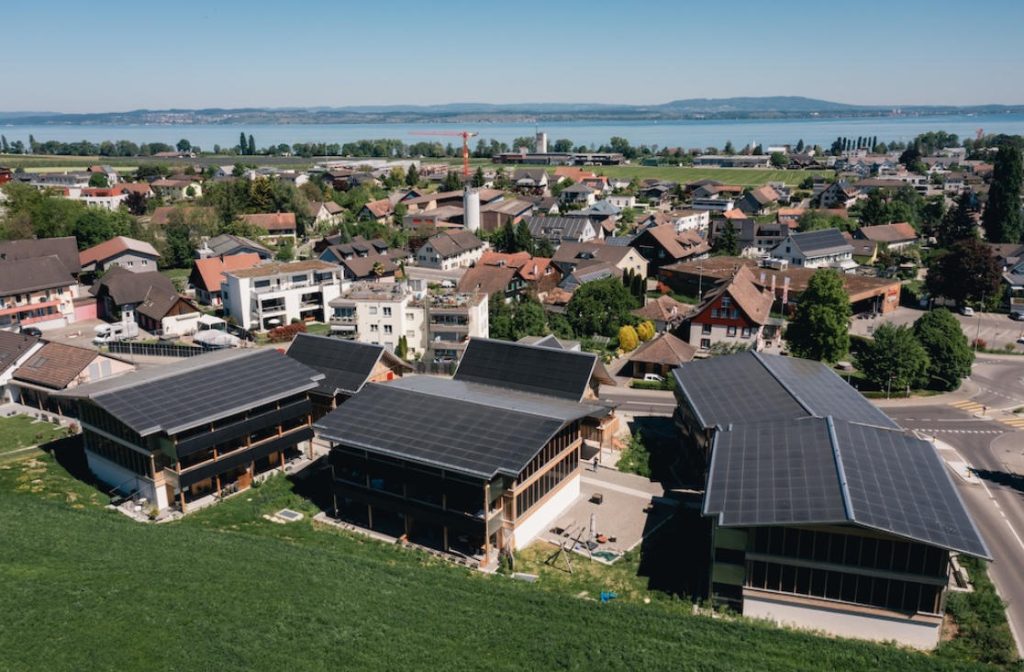
Viewed from the village square, Alte Schmitte appears to be an ordinary residential neighbourhood. PV modules are integrated into roofs and façades rather than added as separate elements, allowing the buildings to exhibit a cohesive architectural appearance.
Behind that appearance, however, is an energy system that enables twenty-seven households to live in a community which generates far more electricity than it consumes. More than four times as much, in fact.
The community is in the Swiss village of Güttingen which lies on the shores of Lake Constance. A former smithy – Alte Schmitte –was redeveloped into an energy-efficient residential neighbourhood. The development consists of six buildings: four are newly-constructed timber buildings, two are historic houses which have been renovated. Together they provide 27 rental apartments in the centre of the village – new housing which preserves the character of its village location between the church and community centre.
The project received both the Norman Foster Solar Award from the Swiss Solar Prize and the European Solar Prize 2025 in the category of Solar Architecture and Sustainable Design.
With high levels of energy efficiency the buildings use a Minergie-P building envelope, sheep’s wool insulation, geothermal heat pumps and passive cooling. Minergie-P is a Swiss building certification similar to Passivhaus.
The solar based power system was designed, programmed and is maintained by Solar Energy Anstalt.
The photovoltaic array measures more than 3000m² and provides 413.7 kWp of generation capacity across roofs, balconies and building façades. The annual electricity production from these panels is 371,000 kWh, yet annual energy demand from the twenty seven occupancies is around 92,400 kWh – most of the surplus energy is exported to the public grid.
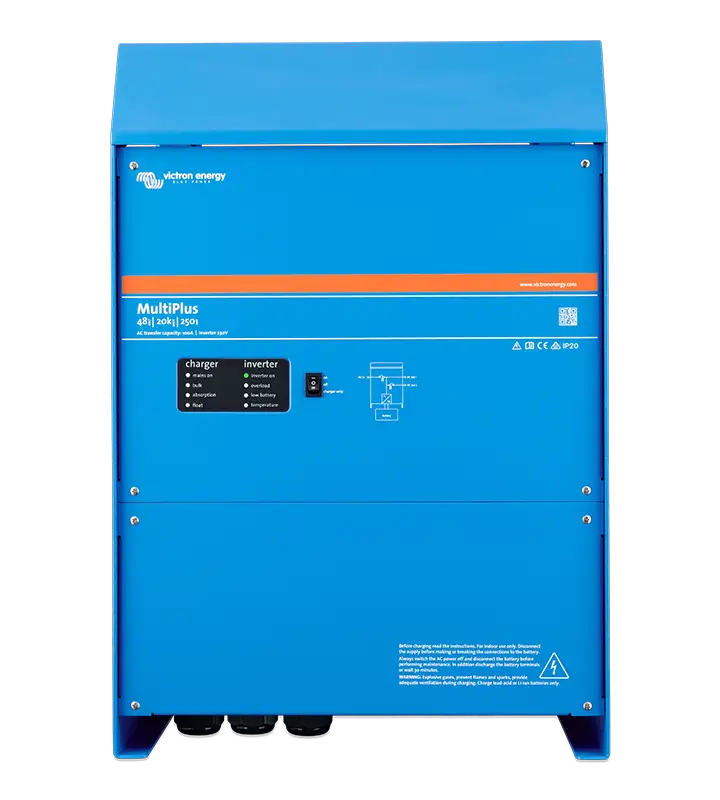
Six MultiPlus-II 48/15000 inverters configured for three-phase supply provide 90 kVA of power. They’re sized for peak loads, rather than annual kilowatt-hours. In off-grid mode, whenever the grid has failed, this architecture is designed to supply priority loads via a separate emergency power sub-distribution system: that ensures continuity of building services, elevator, ventilation, control systems, lighting, security, and access control.
It’s important to note that when the grid fails the MultiPlus-II inverters make the switch to private supply in under 20 milliseconds—faster than a conventional UPS.